For many stroke survivors, sitting up independently can be harder than expected. A person may be able to stay awake, understand instructions and even move one arm or leg, yet struggle to sit upright without leaning, losing balance or needing support.
This difficulty is not simply a matter of reduced strength. A stroke can affect the brain’s ability to coordinate posture, balance, sensation and movement. Because sitting is the foundation for many everyday activities, improving this ability is an important part of rehabilitation.
What Happens When Sitting Becomes Difficult After a Stroke?
Sitting upright looks like a simple movement, but the body has to perform several tasks at once. The brain needs to coordinate the muscles of the trunk, pelvis, neck and limbs while constantly responding to changes in body position.
After a stroke, a survivor may:
- Lean toward one side while sitting
- Slide forward or backward in the chair
- Need their hands to stay supported
- Have difficulty moving from lying to sitting
- Lose balance when reaching
- Struggle to remain upright for long
- Feel unsure when there is no back support
Some people may not even recognize that they are leaning. This can happen when the stroke affects the way the brain processes information about body position.
Why Is Sitting Up After Stroke So Difficult?
There can be several reasons for difficulty sitting after stroke, and more than one may be present in the same person.
1. The Trunk May Have Become Weak
The trunk provides the central support needed to keep the body upright.
Following a stroke, weakness may affect the abdominal, back and pelvic muscles. Instead of making small adjustments to maintain posture, the survivor may collapse toward the weaker side or rely heavily on external support.
This stroke trunk weakness can also make other movements harder, including reaching, transferring and standing.
2. Balance Reactions May Be Reduced
Sitting independently requires the body to react when its position changes.
For example, if a person reaches for an object, their centre of gravity shifts. A healthy nervous system automatically makes adjustments to prevent a fall.
After stroke, these balance reactions may be slower, smaller or poorly coordinated. As a result, even a small movement can make the person feel as though they are about to fall.
3. The Brain May Have Difficulty Understanding Body Position
Balance is not controlled by muscles alone.
The brain receives information from the eyes, inner ear, muscles and joints to understand where the body is in space. A stroke can interfere with how this information is interpreted.
A survivor may therefore have difficulty recognizing that their trunk has moved away from the midline.
This can contribute to persistent leaning or an unusual sitting posture.
4. One Side of the Body May Not Provide Enough Support
When one side is significantly weaker, the survivor may unconsciously shift their weight toward the stronger side.
Over time, this can create an uneven sitting posture.
The person may appear to be sitting upright at first glance, but their pelvis and trunk may actually be positioned asymmetrically.
5. Coordination Can Be Affected
A person doesn’t necessarily need severe paralysis to have trouble sitting.
The muscles responsible for posture may still work, but they may not activate at the right time or with the right amount of force.
This lack of coordination can make sitting look unstable even when individual muscles have some strength.
6. Stiffness or Changes in Muscle Tone
Some stroke survivors develop increased muscle tone or stiffness.
When the trunk, hips or legs become stiff, changing position becomes more difficult. The survivor may struggle to adjust their posture when they begin to lose balance.
7. Fear of Falling
After experiencing a fall or feeling unstable, some survivors become afraid of sitting without support.
They may keep both hands firmly on the bed or chair and avoid reaching or shifting their weight.
Although caution is understandable, avoiding movement altogether can limit opportunities to practise the skills required for greater independence.
Why Is Trunk Control After Stroke Important?
Trunk control after stroke is closely connected with functional independence.
The trunk acts as the body’s central platform. A person needs reasonable control of it to perform activities such as:
- Sitting at the edge of the bed
- Reaching for objects
- Getting dressed
- Moving from bed to chair
- Standing up
- Walking
- Using the toilet
- Eating while seated
Poor trunk control can therefore affect much more than sitting.
Improving trunk control is generally not about simply doing abdominal exercises. Rehabilitation focuses on teaching the person to control their body during meaningful movements and everyday tasks.
How Is Sitting Balance Assessed During Stroke Rehabilitation?
Before starting exercises, a stroke rehabilitation in bangalore may observe how the survivor manages different sitting situations.
They may look at:
Static sitting: Can the person remain upright without losing balance?
Weight shifting: Can they move their weight from one side to another?
Reaching: Can they reach for an object without falling?
Midline orientation: Can they recognize and maintain a more centered position?
Transitions: Can they move from lying to sitting?
Postural reactions: How does the body respond when balance is challenged?
The assessment helps the rehabilitation team understand why the person is struggling rather than simply telling them to “sit straight.”
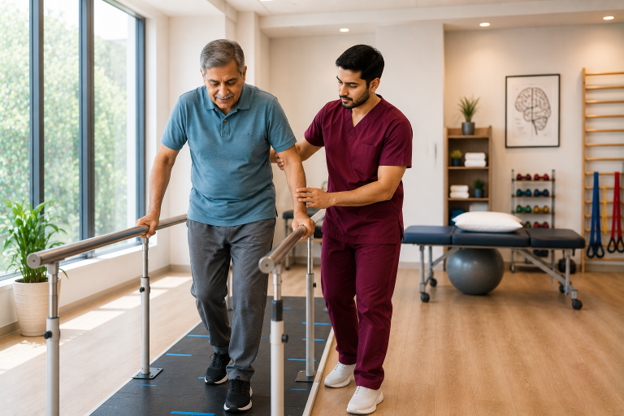
Sitting Balance Rehabilitation: What Can Therapy Involve?
A rehabilitation programme is adjusted according to the survivor’s stroke severity, strength, balance, cognition and medical condition.
Practising Supported Sitting
Early rehabilitation may begin with the survivor sitting with appropriate support.
The therapist may gradually reduce the amount of support as control improves.
Finding the Midline
The survivor may practise recognizing what a balanced sitting position feels like.
Visual feedback, mirrors, therapist guidance or specific activities may be used to help the person understand where their body is positioned.
Controlled Weight Shifting
The survivor may practise moving their body weight gently from one side to another.
This teaches the trunk to respond to movement without immediately losing balance.
Reaching Activities
Reaching for a familiar object can turn balance practice into a functional activity.
The therapist may gradually change the object’s position so the survivor learns to control the trunk while moving the arms.
Moving From Lying to Sitting
The transition from lying down to sitting is itself a rehabilitation skill.
A therapist can break the movement into manageable stages and teach the survivor how to use the stronger and weaker sides safely.
Functional Sitting Practice
Eventually, therapy can incorporate activities that resemble everyday life—such as grooming, eating, dressing or handling objects while seated.
This helps connect improved sitting control with practical independence.
Can Stroke Survivors Improve Their Sitting Ability?
Yes, improvement is possible, although the amount and speed of recovery differ between individuals.
Progress may look different from person to person.
For one survivor, success might mean sitting unsupported for a few minutes. For another, it may mean reaching for an object without losing balance or transferring safely from the bed to a chair.
Recovery should therefore be measured against the person’s individual functional goals, rather than a fixed timeline.
Regular, appropriately supervised rehabilitation can provide repeated opportunities to practise these movements.
What Can Caregivers Do When a Stroke Survivor Cannot Sit Independently?
Caregivers should prioritize safety over forcing the person to sit without assistance.
Helpful principles include:
- Follow the therapist’s positioning recommendations.
- Provide the level of support advised by the rehabilitation team.
- Keep the environment free from obstacles.
- Avoid suddenly pulling the survivor into a sitting position.
- Watch for fatigue during practice.
- Do not continue an exercise if the person develops significant pain, dizziness or distress.
- Ask the rehabilitation team to demonstrate safe bed mobility and transfers.
Most importantly, caregivers should not assume that being unable to sit independently means the survivor cannot progress. Sitting can itself be a rehabilitation goal.
When Should Difficulty Sitting After Stroke Be Reassessed?
A person who is recovering from stroke may have good and bad days. However, a new or sudden deterioration should not automatically be considered normal fatigue.
Medical advice should be sought if the survivor suddenly develops:
- New or worsening weakness
- A new change in speech
- New facial drooping
- Sudden confusion
- Severe dizziness
- Loss of consciousness
- A sudden severe headache
- New difficulty coordinating movements
These may indicate a medical emergency and require immediate assessment.
Conclusion
Difficulty sitting after stroke can result from trunk weakness, impaired balance reactions, altered body awareness, poor coordination, changes in muscle tone and other neurological effects. For some survivors, fear of falling can add another layer of difficulty.
Effective rehabilitation looks beyond simply strengthening the muscles. It works on trunk control after stroke, postural alignment, weight shifting, balance reactions and functional movement.
With an individualized rehabilitation programme, repeated practice and appropriate support, many stroke survivors can gradually develop better sitting control and move toward greater independence in their daily activities.